
Mary's Story
Mary Randall Vickers – an obituary
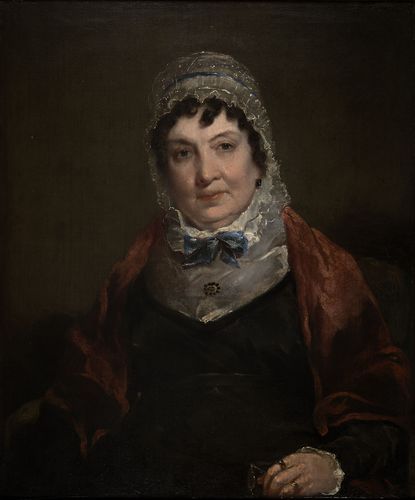
It is her fortitude that sets Mary apart. She looks out at us from her portrait, both clear- and kind-eyed, but with a determined set of her chin: you messed with Mary (as several tried to do) at your peril.
Mary Randall Vickers, who was married and widowed twice, inherited and ran two businesses whilst raising four of her own children and four stepchildren. Twice she went into business with partners who kept her money but not their side of the agreement; in both cases she went to law to recover what they owed her. Separately, a lengthy Chancery court claim against her late second husband’s estate eventually deprived her and their children of most of their properties and the larger part of their rental income. But none of this broke her.
To the end, she trusted the God in whom her early-Methodist family had led her to believe; one of her final acts was to renew her quarterly ticket for the new, vast, Brunswick Chapel which had just been built to serve the burgeoning Methodist populace of north Leeds which she had supported all her life.
Mary never lived outside a square mile in the heart of Leeds. Yet in her lifetime Britain’s global preeminence was established, often violently (Britain or its proxies were at war, somewhere in the world, for 59 of her 69 years); and some of her family would benefit from that preeminence. In 1808, her dear eldest son, Robert Howl Philipps, joined the East India Company - widely considered as then the most powerful private company in the world - later taking part in the First Anglo-Burma war and becoming Assistant Commissioner for Arakan (now Rakhine state in Myanmar).
All around her Leeds was growing colossally fast and was industrialising. A city built on woollen cloth merchanting turned quickly also to manufacturing. Mary was a contemporary of some of Leeds’ “great men” including Gott, Marshall and Murray; and in 1811 she co-invested with Zebulon Stirk (a fellow Methodist) in a steam-engine for machine-making. She may be the first woman in Leeds known to invest in steam power.
Mary’s father, Robert Randall, was a successful grocer and cheesemonger on Briggate (then, as now, one of the most important commercial streets in Leeds). Mary joined him in that business and was clearly a natural. Robert said of his daughter that half of every shilling he possessed was due to Mary’s efforts. The family was able to invest in several dwellings being built in St Peter’s Square (on Quarry Hill); Mary would live in one of these for most of her adult life.
Mary married, for the first time, relatively late – aged almost 30 – to a “Dissenting Minister”, Samuel Philipps; but he died only two years later, leaving her with two young sons. The younger of these contracted smallpox and died the following year. Two of her own brothers and both her parents also died in the next years, leaving her to run the grocery business with a younger sibling. She was well acquainted with grief, and with having to take responsibility.
In 1798, Mary remarried, to a widower, Joseph Vickers, who himself had four young children. Mary’s journal makes clear that this was another love-match, not a marriage of convenience. In the next years they had three more sons together. Joseph was a patten-maker, successful enough to buy several properties on Briggate which he rented out (the 1811 Leeds Directory cites “Vickers’ yard, Briggate” as the address of a lawyer). But Joseph died in 1808, leaving Mary alone with four sons of her own and four stepchildren, two businesses to run and a bundle of potential problems for the future.
Zebulon Stirk turned out to be an inventive engineer but a bad business partner: he failed to keep proper accounts and never shared the profits of the business with Mary as had been agreed. Eventually she had to go to law to recover her money, ten years later.
Perhaps as a result, she was more careful when taking one of her stepsons into his father’s patten-making trade. She wrote a clear Deed of Partnership with agreed arbitration clauses in case of dispute; eventually she had to enforce these but nonetheless over the years lost money – at least £600 (around £45,000 now). Later she started patten-making under her own name, in time bringing in two of her younger sons who would continue it after her death.
According to Mary’s Deposition to the High Court of Chancery in the claim against Joseph’s estate, they owned nineteen properties in the city centre, eleven on Briggate and eight on St Peter’s Square, producing rents of around £30,000 / year in current (2026) value. Fourteen of these properties were forcibly sold in April 1818 following a Chancery Court order, both cutting the rental income by more than three quarters and drastically reducing the family assets. Mary quietly noted in her Will that she would have had more to leave to her children if it had not been for “that unfortunate Chancery business”. Ultimately it may have contributed to the later decision of Mary’s son, Benjamin Randall Vickers, to establish a new trade as an oil merchant; that business is still operating today.
Mary remained close to two of her younger siblings and to all four of her own born sons, although she never again saw Robert after he sailed to India in 1808. But two of her stepchildren were more of a burden. One stepson was bankrupted in 1824 and fled his creditors, whilst Mary confided (in 1817) in her private journal that one of her stepdaughters had lost all her friends as “she has not one amiable trait in all her composition”.
Mary died peacefully, surrounded by family, in her last home, near Brunswick Chapel where she was buried. Sadly, the site has been built over and her grave is lost.
Her greatest legacy is the way she lived her life: consistent in her values and behaviours; faithful both to her beliefs and to her family and friends; ready to try new ideas and technologies at a time of innovations, wars, social upheaval and turbulence; and facing all of life’s difficulties, losses and sorrows with fortitude.
Mary Vickers, née Randall, born in Leeds 11th February 1757, died in Leeds 7th June 1826
© Peter Vickers, 2026